
Bridging the DB-DC Gap
Bringing Longevity Pooling to Defined Contribution Savings
What the Market Needs
A Defined Benefit (DB) plan delivers retirement income. A Defined Contribution (DC) account delivers a balance. The shift from DB to DC gives employees ownership of their retirement savings. It also moves longevity risk, the risk of outliving those savings, from employers to individuals.
Providers have worked hard to close that gap, but today’s solutions draw on only two options. Figure 1 rates each against the three needs set out in The Retirement Trilemma Whitepaper, longevity (L1), liquidity (L2), and legacy (L3).1 A traditional DB pension plan pools longevity risk and guarantees income, but gives up access to savings and limits what could pass to heirs. A DC account keeps access and legacy but leaves each person to manage longevity alone. There is no common option between the two poles. Hybrids such as partial annuitization do not create a third option. They divide the balance between the two poles that already exist, and every dollar still faces the same tradeoff.
The market needs a retirement account an individual owns, plus longevity pooling. It should work for plan sponsors who want to provide benefits without a pension-type liability. CLIP bridges the gap.
CLIP in brief. CLIP adds longevity pooling to retirement accounts people already own. Each member keeps savings in a Personal Account, such as a 401(k) or an IRA. When a member exits through death or withdrawal after retirement, a pre-set portion of their remaining savings, pledged in advance, goes to a shared Community Fund. These contributions become credits allocated to remaining members. Members can draw on credits for additional retirement income, but the income is not guaranteed.
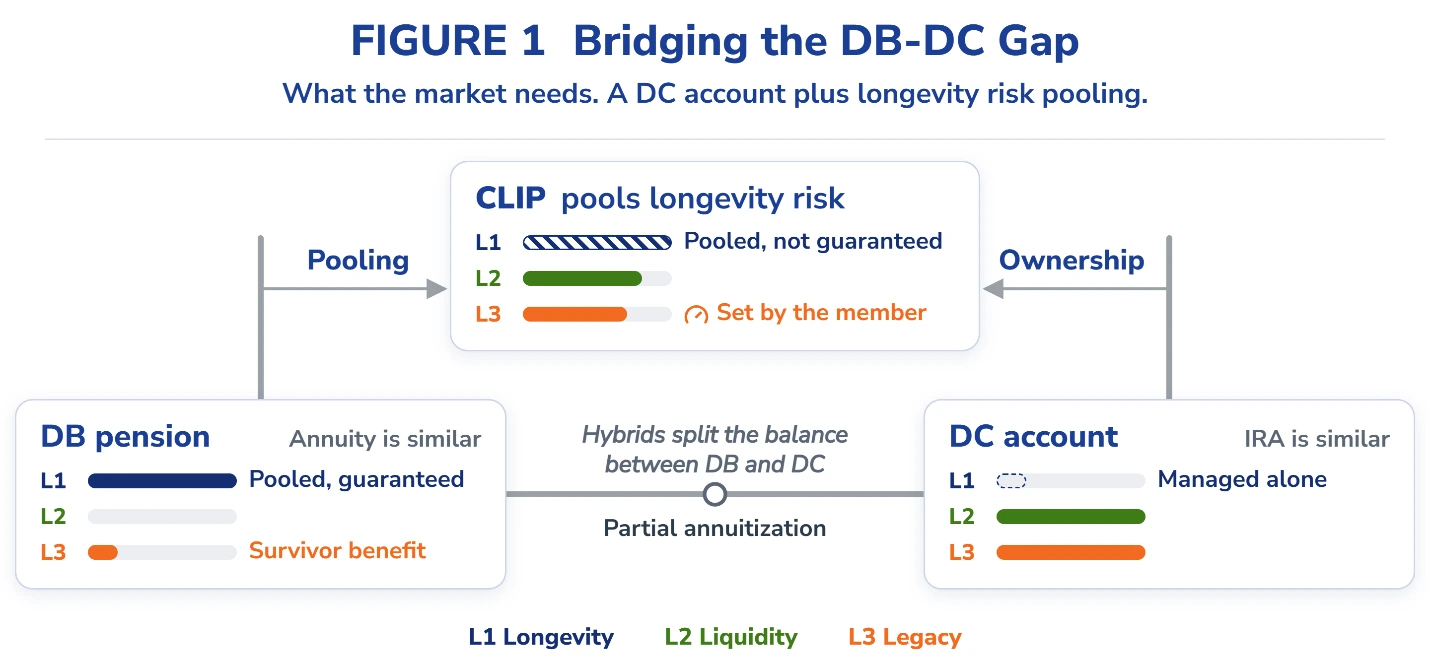
Figure 1 shows how CLIP, the Community Long-term Income Plan,2 adds longevity risk pooling to a DC account, bridging the two poles of DB and DC designs.
For the individual, CLIP adds longevity pooling to the DC account they already own. Retirement savings stay in their hands, access and legacy remain theirs to manage, and no insurance guarantee is included. This is pooling without paying a premium up front.
It is the option that has been missing.
For the employer, CLIP ends a standoff. Employees cannot make their employers offer DB plans, and few employers will return to them, apart from those offering cash balance plans. Employees are left with DC plans and no pooling. CLIP lets an employer keep its DC plan and facilitate CLIP membership, without taking on pension liability.
What Makes CLIP Different
CLIP rests on three simple ideas. The member owns their Personal Account and builds credits in their Credit Account. On exit after retirement, they contribute to the Community Fund.
Because the contribution is made at exit rather than up front, savings stay in the member’s hands for as long as they remain a member. A member can also join while still working. Credits start to build from the day they join, not the day they retire, so pooling becomes part of the savings for retirement rather than a purchase made at retirement.
Any eligible account. CLIP is not tied to one type of account. A member can link it to any eligible account, meaning one that has a trackable value, is owned by the individual, and gives the individual full rights to its terminal value as the death benefit. A DC plan account can qualify, and so can the IRAs and investment accounts many people already hold.
No transfer to begin. A member joins, keeps their assets where they are, and remains a member until they exit. CLIP does not require reallocating or transferring assets to their CLIP Credit Account to begin participating. Indeed, there is no mechanism for a member to make a deposit into their Credit Account. If the member later moves their Personal Account, to another 401(k), IRA, or a bank account for example, the new account is simply linked to CLIP in place of the old one. Membership continues, and decisions about investments and tax treatment remain the member’s own. Figure 2 shows how membership follows the member from one account to another.
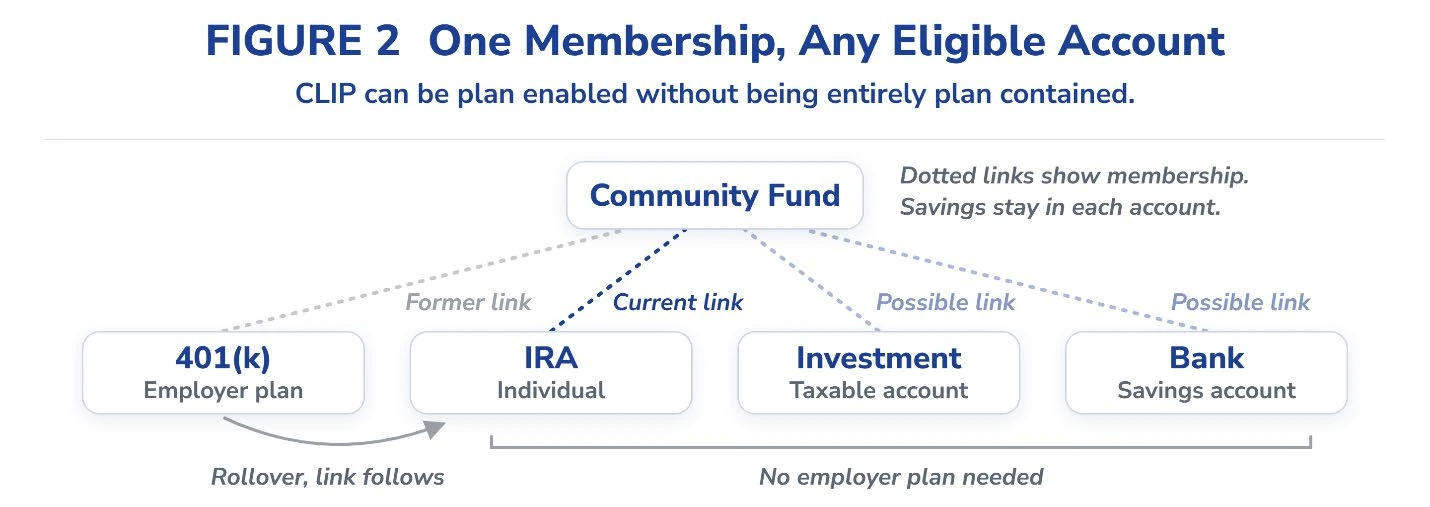
No employer required. For the same reason, CLIP does not depend on an employer at all. Anyone with an eligible account, including the self-employed, can join directly, with no plan sponsor involved. The reason to join is simple self-interest in more retirement income from the retirement savings that the member continues to own.
Self-selected retirement income. At retirement, a member selects the amount of retirement income that they wish to receive to meet their needs. This income is funded from both the Personal Account and the Credit Account. The member therefore has two sources of retirement income, their own savings and the credits generated through participation in the community.
No guarantee, and no unfunded promise. CLIP pools longevity risk. It does not promise a specific income, and that difference from a DB pension is deliberate. A DB pension promises a benefit the employer must stand behind. CLIP needs no such backing because the pool funds itself.3 Every credit paid to a surviving member comes from a contribution by a member who has actually exited, nothing more. What goes out always equals what came in, so the pool clears itself, and no employer or other party has to cover a shortfall.
A guarantee by choice. Some individuals will still want a guaranteed floor. They can add one separately by choosing and paying for an insurance product such as an annuity, sized to the portion of income they want guaranteed.a The plan sponsor and the pool do not provide it.
Why the Gap Exists
The move from DB to DC is familiar.4 In a DB plan, the employer funded the promise, invested the assets, and carried both investment and longevity risk, which was pooled automatically across everyone in the plan. In a DC plan, each participant carries both risks alone.
Much of this change has been good. Employees own their savings, and those savings are visible, portable, and under their control. Automatic enrollment, automatic escalation, and target date defaults have made DC plans steadily better at building savings. The payout phase is where the model remains incomplete. Turning a balance into income that lasts an unknown lifetime is a problem most people have never had to solve, and solving it alone means planning for a long life without knowing how long that life will be.
The problem is arriving at scale. In the United States, the population aged 65 and over is projected to grow from about 56 million in 2020 to more than 80 million by 2040.5 This generation holds its retirement wealth in accounts it owns directly, and that ownership has shaped what it expects in access, control, and legacy.
At retirement, many people leave their savings in the employer’s plan for a time, and many eventually roll them into an IRA, which keeps tax deferral and offers broader investment choice and direct control. Rollovers from employer plans to traditional IRAs are significant, reaching $670 billion in 2022 alone.6 Others take installments or cash out. A much smaller group uses part of their savings to buy an annuity. People without an employer plan, including many self-employed workers, reach the same point through an IRA or a taxable investment account. Whatever the account, the balance arrives at retirement with no pooling attached.
Employers feel the problem too. Many would like to offer something that works more like a pension. Very few want to return to DB plans, with their funding obligations, balance sheet liabilities, and commitments that run for decades.
The individual’s need and the employer’s constraint point in the same direction. Don’t go back to DB plans. Keep the best features of DC plans and add longevity risk pooling.
Why Current Solutions Fall Short
The gap has not gone unnoticed. Plan sponsors, recordkeepers, asset managers, consultants, and insurers have all looked for ways to help people turn a retirement account balance into lasting income. Each solution sits at one of the two poles in Figure 1, or divides the balance between them.
At the DC pole. The savings stay in the plan or move to an IRA or another account, and the individual draws them down over retirement, sometimes with a managed payout or an investment strategy built for retirement. The Retirement Trilemma Whitepaper calls this systematic withdrawal. Liquidity and legacy stay high. Longevity risk is managed alone, and the income floor is uncertain.
At the DB pole. The individual uses savings to buy an annuity, with an insurer standing in for the employer. Longevity risk is transferred, and the income floor is strongly protected. The premium is committed, though, and the retiree gives up most of their liquidity and much of their legacy.
A mix of the two. In-plan annuity options, and target date strategies that direct part of the balance toward guaranteed lifetime income as retirement approaches, are forms of partial annuitization. They are real progress for sponsors that want to offer guaranteed income. They do not change the tradeoff. They divide the balance between the two poles, and guaranteed income is still bought by committing retirement savings.
Few people choose an annuity voluntarily. Economists have puzzled over low annuity take-up for decades, a pattern known as the annuity puzzle.7 The Trilemma offers a simple explanation. Retirees value access to their money and the ability to leave something behind, and an annuity asks them to give up ground on both. Seen this way, low take-up is a reasonable outcome and consistent with what the Trilemma indicates.
Some designs move back toward the DB pole through the employer. A cash balance plan is a DB plan that reports a balance rather than an income, and it is sometimes paired with a 401(k). Pooling occurs only for those who choose lifetime income at retirement, and choosing it gives up liquidity and legacy much as an annuity purchase does. The employer carries the longevity risk, so these designs restore pension-like income only by putting part of the pension liability back on the employer.
Pooling without a guarantee is not new either. Tontine-style designs such as collective DC plans, let members share longevity risk directly, without an insurer. They still require members to commit capital to the pool up front, which limits liquidity and legacy in much the same way.
Experience outside the United States shows similar challenges. India moved new government employees from DB to DC in 2004 and has since introduced an optional assured payout, reflecting pressure to restore something pension-like.8
When Singapore’s DC system first offered a lifetime annuity on a voluntary basis, take-up was low, and the government later made the annuity compulsory for most members.9 The United Kingdom moved in the opposite direction. Its 2015 Pension Freedoms reform removed what had effectively been a requirement to buy an annuity, and annuity purchases fell by roughly 75% from their 2012 peak in the years after the reform.10
Given the choice, many chose liquidity over a guarantee.
Where This Leads
CLIP fits the roles providers already play. Plan sponsors can offer it alongside the investment menu without taking on pooling liability. Recordkeepers and administrators are the natural platform, and bringing members from many plans into one Community Fund gives small-plan members the benefit of pooling scale. Asset managers and insurers can retain the assets they manage, since CLIP’s added income comes from longevity risk pooling rather than investment returns. Custodians and advisors gain a pooling option for clients at the moment of retirement. How CLIP is offered in any given market, and the responsibilities of those who offer it, will depend on applicable regulatory requirements.
The move from DB to DC gave people ownership of their savings and took away the longevity pooling that came with a pension. The solutions offered since then are a combination of the two poles but not a true blending.
CLIP spans the gap. It adds longevity pooling to the accounts people already own, without asking them to surrender their savings and without asking employers to take back the risks they set aside.
Notes
- a Some annuities provide minimum guarantees. Others function like an investment account until maturity or annuitization at a late age. CLIP can be coordinated with several of these, depending on the annuity design.
- Shimpi, P. A. 2026. “The Retirement Trilemma: Why Retirement Income Decisions Are So Difficult.” VivaLogic Whitepaper. https://www.vivalogic.com/articles/retirement-trilemma
- Shimpi, P. A. 2026. “Understanding CLIP: An Introduction to the Community Long-term Income Plan.” VivaLogic Whitepaper. https://www.vivalogic.com/articles/understanding-clip
- Shimpi, P. A. 2026. “From Ex-Ante to Ex-Post: Introducing Empiric Mortality Pooling for Retirement Income.” SSRN working paper, August 28. https://doi.org/10.2139/ssrn.7377259
- Poterba, J., Rauh, J., Venti, S., and Wise, D. 2007. “Defined Contribution Plans, Defined Benefit Plans, and the Accumulation of Retirement Wealth.” Journal of Public Economics 91(10): 2062-2086.
- Vespa, J., Medina, L., and Armstrong, D. 2020. “Demographic Turning Points for the United States: Population Projections for 2020 to 2060.” Current Population Reports P25-1144. U.S. Census Bureau.
- Holden, S., Bogdan, M., and Schrass, D. 2026. “The Role of IRAs in US Households’ Saving for Retirement, 2025.” ICI Research Perspective 32(7). Investment Company Institute. https://www.ici.org/system/files/2026-06/per32-07.pdf
- Yaari, M. E. 1965. “Uncertain Lifetime, Life Insurance, and the Theory of the Consumer.” Review of Economic Studies 32(2): 137-150; Davidoff, T., Brown, J. R., and Diamond, P. A. 2005. “Annuities and Individual Welfare.” American Economic Review 95(5): 1573-1590.
- Press Information Bureau, Government of India. 2026. “Backgrounder on India’s Pension Landscape.” May. https://static.pib.gov.in/WriteReadData/specificdocs/documents/2026/may/doc202657865401.pdf
- Fong, J. H. Y., Mitchell, O. S., and Koh, B. S. K. 2011. “Longevity Risk Management in Singapore’s National Pension System.” Journal of Risk and Insurance 78(4): 961-982.
- Cannon, E., Tonks, I., and Yuille, R. 2016. “The Effect of the Reforms to Compulsion on Annuity Demand.” National Institute Economic Review 237(1): R47-R54. https://doi.org/10.1177/002795011623700116
Keep a copy
Download the PDF of this paper to read offline or share. The text above is the same paper.