
The Retirement Trilemma
Why Retirement Income Decisions Are So Difficult
One Pot of Savings, Three Jobs
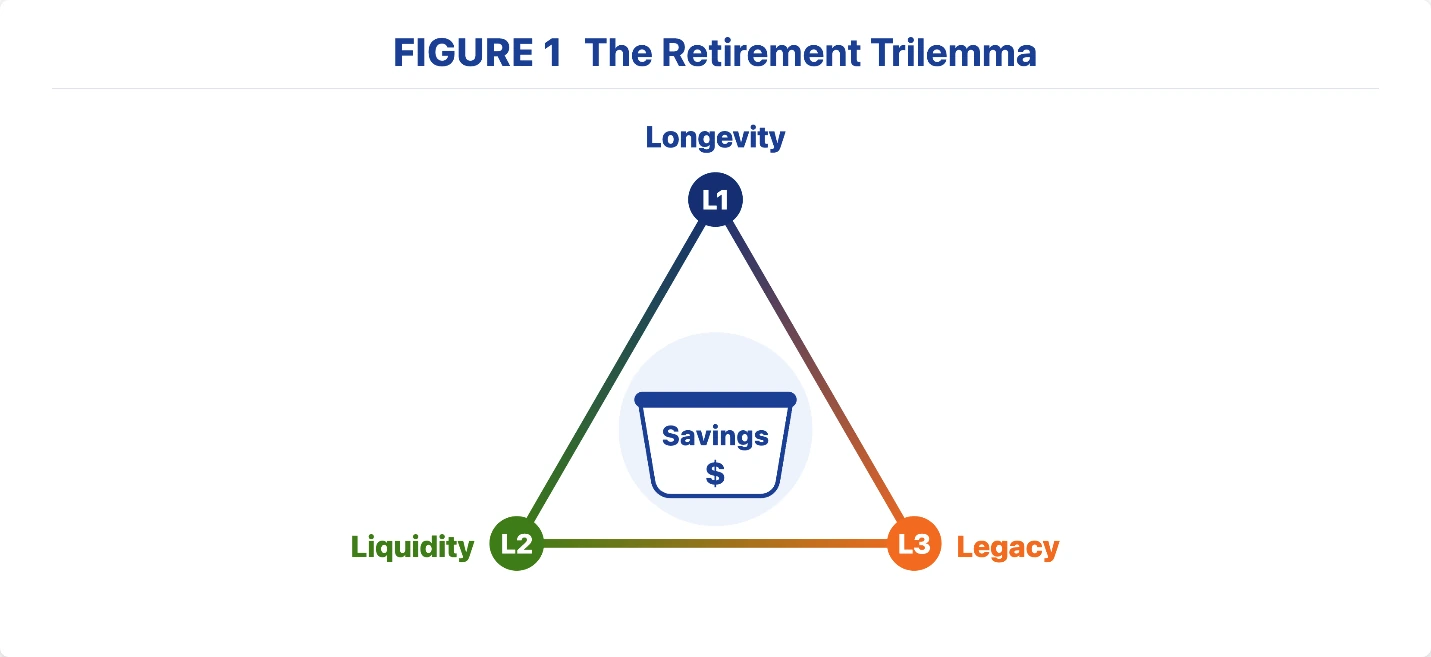
Ask most people approaching retirement what worries them and you will hear several answers. Will my money last? What happens if I need money for a major expense or an emergency? Will I have anything left to leave my kids? While these may sound like separate concerns, they are three expressions of a single structural problem. I have only one pot of retirement savings and it has to do three jobs at once.
This issue is not new. Researchers and practitioners have independently identified versions of this conflict1. The technical research behind this White Paper adopts the term coined by the Australians2, The Retirement Trilemma.
The Retirement Trilemma at Stake
The three goals at stake are labeled L1, L2 and L3 in my research3. It is a convenient shorthand as these goals are defined and retirement income solutions are explored. L1 is longevity reliability, whether retirement income lasts as long as the retiree does. L2 is liquidity, whether the retiree has unencumbered access to their money if and when they need it. L3 is legacy, whether there is anything left for the people they care about.
Most retirees have a reason to desire all three goals. Strengthening one goal typically weakens the ability to achieve at least one of the others. That is the Retirement Trilemma.
What Each Goal Protects
Longevity Reliability. Pooling longevity risk with others genuinely helps with retirement security. A retiree who shares the risk of outliving their savings with a larger group of fellow retirees tends to get more income from their own savings than going it alone. The pool provides extra support for those who live longer, funded by those who don’t. Anyone participating in this type of pool should recognize that a pool works both ways. To receive more if you live longer, a pool member must be willing to contribute more to the pool if they don’t live as long. This is a tradeoff that seems reasonable since more money is needed to support longer life, if the mechanism to implement the tradeoff is demonstrably fair.
Liquidity. This is not only about the freedom to spend as you please. As retirees age, unplanned costs arise unexpectedly, even with the best of planning. A health event, a long-term care need, a housing change, or support for a family member can all create a draw on savings. Without access to those savings, meeting such needs becomes increasingly difficult at later ages.
Legacy. Legacy to family and loved ones is often treated as a residual benefit, a bonus of whatever is left over after retirement when someone passes away. But it is not so simple. The reverse situation matters just as much but is talked about far less. If a retiree exhausts their savings, the burden of making ends meet doesn’t just disappear. There may be social safety nets that can pick up the shortfall. Unfortunately, this burden often shifts to family members. The same people who might have received an inheritance are instead making up the shortage of financial support.
The tradeoff between these goals means that retirement planning rarely impacts only the individual retiree. There is more to consider. This makes it a family conversation, whether that is acknowledged as such or not.
The Trilemma as a Threshold and Tradeoff
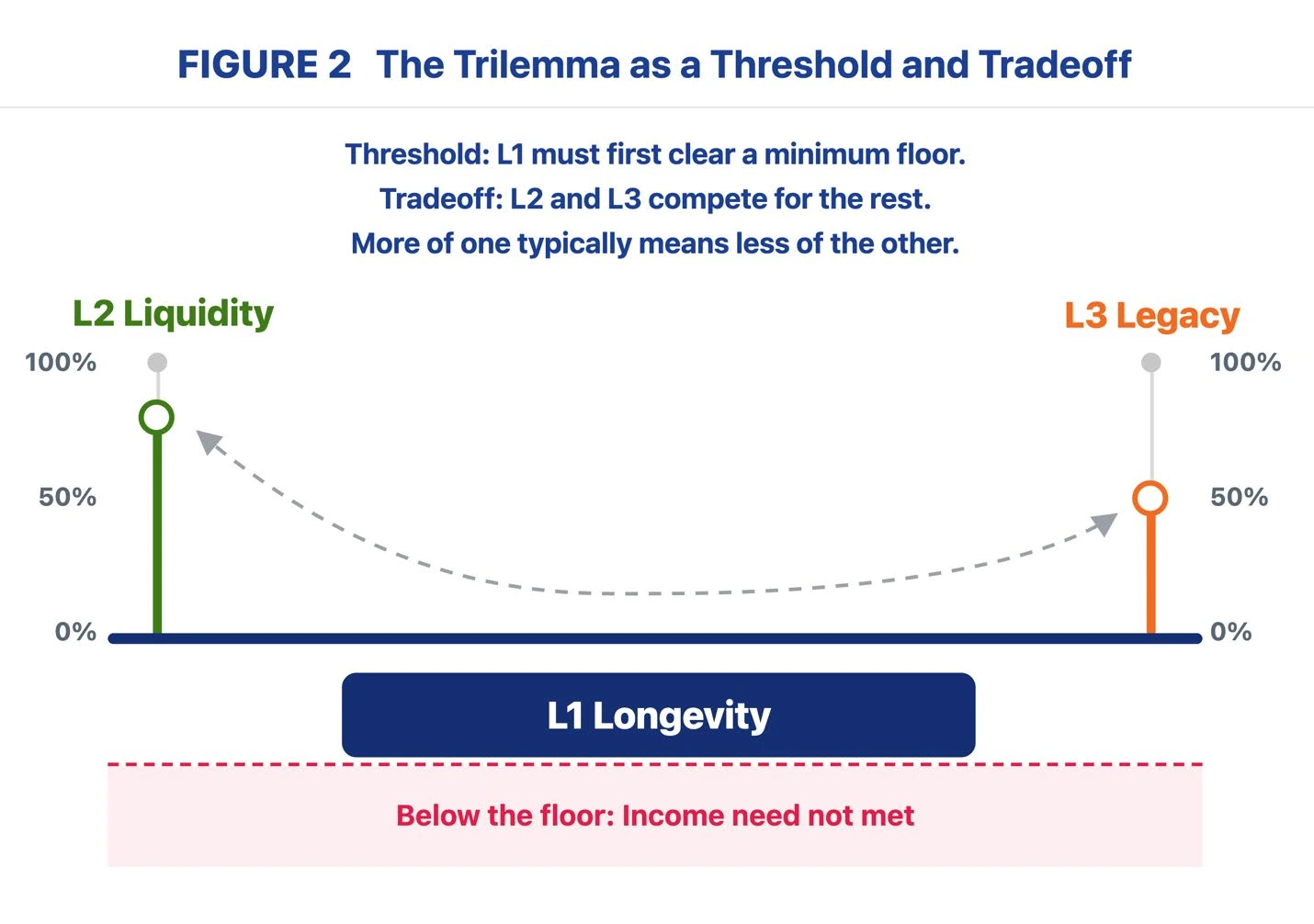
Liquidity and legacy cannot compensate for failing to meet the retiree’s essential retirement income floor. Longevity reliability is different from the other two goals. It has to be met first at a level sufficient to cover the retiree’s minimum expenses.
Below the floor, the retirement income need is simply not met and the risk of running out of money becomes very real. There may not be enough available to meet the other two goals.
Above the floor, the picture is quite different. Liquidity and legacy start competing for whatever capacity remains. Depending on the retirement product structure, more of one typically means less of the other.
The research formalizes this approach as a constrained optimization problem that maximizes the retiree’s liquidity and legacy goals, subject to first meeting the longevity income requirement. A retirement strategy that leaves a million dollars to a beneficiary while the retiree has only half the income they need to live on hasn’t solved the problem. It has just moved the shortfall around.
How Current Solutions Resolve the Trilemma
There are many retirement products available in the market. Let us first consider three that are broadly representative, and then introduce a fourth that offers a new path.
Systematic Withdrawal. You retain and manage longevity risk. Savings remain in the retiree’s own retirement account and are entirely liquid. Legacy is high early in retirement and declines as savings are drawn over time to fund income. Because there is no longevity risk pooling or income guarantee, the risk of falling below the income floor becomes real.
Life Annuity. You transfer longevity risk. The retiree pays a lump-sum premium to an insurance company in exchange for an amount of retirement income that is guaranteed for life. The longevity floor is strongly protected. However, the premium is committed and no longer accessible as it would be in an ordinary investment account. On death, a return of premium death benefit may be available where beneficiaries receive the premium paid less the income received by the retiree. The legacy benefit declines as income is paid and may eventually fall to zero early in the retirement years unless the retiree pays an additional premium to enhance the death benefit.
Modern Tontine. You share longevity risk. A fair amount of research has been done on offering modern tontines to retirees, though these are not currently widely available. Participants commit capital up-front to a mortality pool and share longevity risk directly with one another. Longevity reliability improves for survivors without transferring the risk to an insurance company. However, initial capital is committed and contributed upfront, which generally constrains liquidity and legacy.
| Product | L1 Longevity | L2 Liquidity | L3 Legacy |
|---|---|---|---|
| Systematic Withdrawal | Uncertain | High | High |
| Annuity | High, guaranteed | Low | Low |
| Modern Tontine | High, unguaranteed | Low | Low |
A New Path. You choose how you balance L1, L2 and L3. No solution makes the Retirement Trilemma disappear. Each solution described above resolves the competing goals in different ways. An alternative approach would aim to clear the longevity floor while preserving meaningful liquidity and legacy.
Current products make the tradeoffs they were designed to make. The objective of this research is to determine whether a different product architecture could satisfy the longevity reliability requirement without making the same tradeoffs between liquidity and legacy.
That is a design question.
Rethinking the Starting Point
The tradeoffs described above arise partly from assumptions embedded in the product designs rather than what retirees might actually prefer. Rethinking some of those assumptions can lead to a different starting point.
Timing of contribution. Longevity pooling generally assumes that a retiree commits capital to a pool, or pays a premium, at the start, before anything is known about how retirement will actually unfold. Why does the contribution need to be made at the beginning? Advances in data and administrative capabilities make it possible to make calculations using observation of events in real-time, rather than a forecast made decades in advance. This assumption is even more relevant today than ever before.
Longevity vs liquidity. Longevity protection often requires retirees to give up access to some of their savings. Why must pooling longevity risk require that tradeoff? If the pooling contribution can be determined at exit, personal savings can remain with the retiree during retirement, available for both income and unexpected needs.
Legacy by default. Legacy is often whatever remains after the retiree has passed. Why does legacy to beneficiaries need to be determined only as a residual? What if retirees can shape it directly, setting aside the legacy they want to preserve from the outset?
Answering these questions does not make the Retirement Trilemma disappear. All three goals still draw from the same pot of capital, and any benefit created through pooling ultimately has to be funded by other retirees. The balance across all pool members still has to work. What changes is the fairness standard and the timing of that exchange.
Where This Leads
The Retirement Trilemma suggests a different product design objective: Use longevity pooling to fund an income floor while giving retirees greater ability to choose how they balance liquidity and legacy. This is the motivation for VivaLogic’s research and development of the Community Long-term Income Plan, CLIP.
Notes
- Branning, J. K. and Grubbs, M. R. 2010. “Using a Hierarchy of Frameworks to Choose Retirement Strategies.” Journal of Financial Planning: 31-33, and Merton, R. C. 2014. “The Crisis in Retirement Planning.” Harvard Business Review 92(7–8): 43-50.
- Challenger Ltd / Mercer. 2024. Solving the Retirement Trilemma. https://www.challenger.com.au/institutional/Articles/Solving-the-retirement-trilemma
- Shimpi, Prakash, From Ex-Ante to Ex-Post: Introducing Empiric Mortality Pooling for Retirement Income (August 28, 2026). Available at SSRN: https://ssrn.com/abstract=7377259 or http://dx.doi.org/10.2139/ssrn.7377259
Keep a copy
Download the PDF of this paper to read offline or share. The text above is the same paper.