
Understanding CLIP
An Introduction to the Community Long-term Income Plan
What Is CLIP
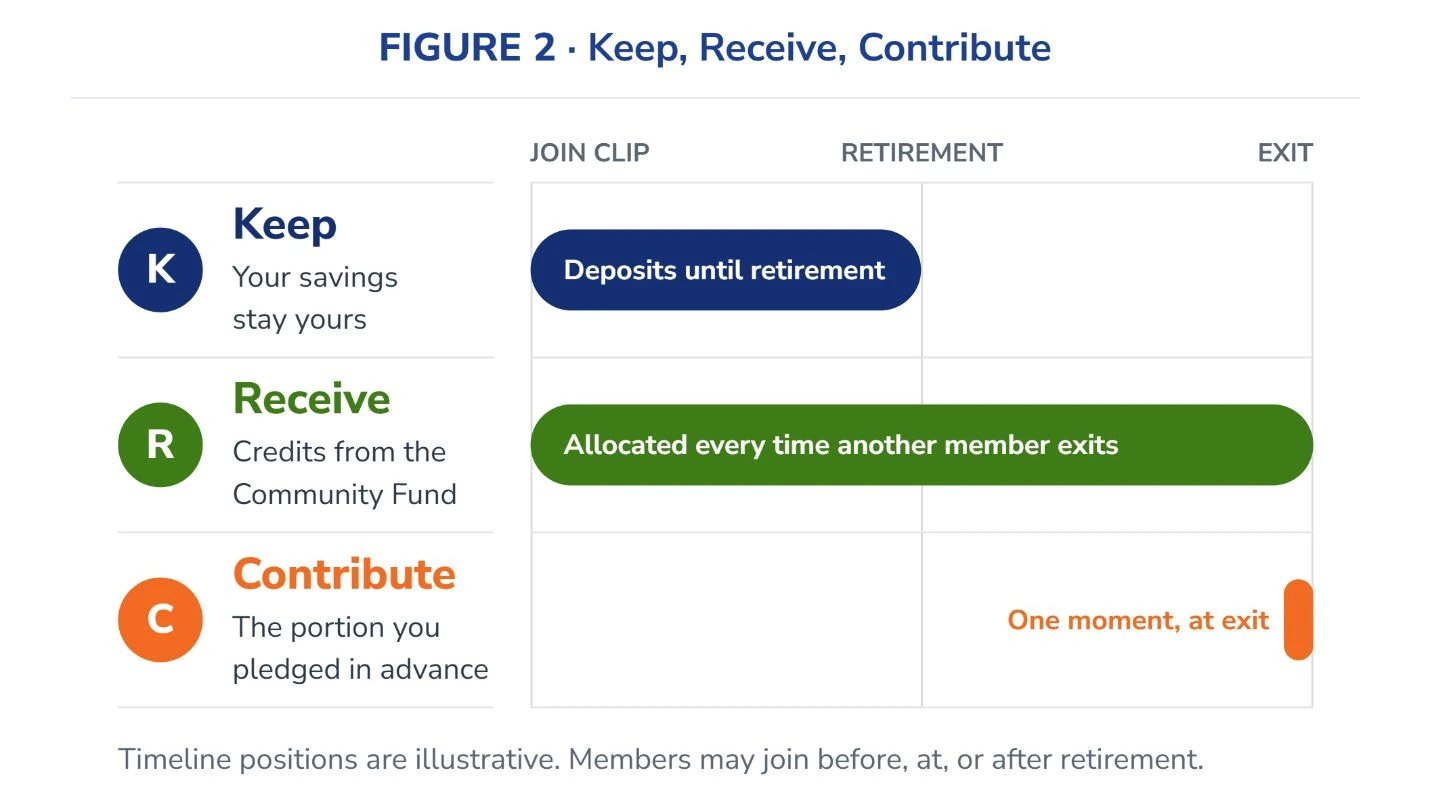
CLIP, the Community Long-term Income Plan, is a retirement income product that adds a second source of income to a person’s own savings. A person who joins CLIP becomes a member of a pool of fellow savers. From that point on, three simple things are true. What the member already owns stays theirs. What other members contribute to the pool over time become credits that each member receives. And, what the member eventually contributes when it is their turn to exit, is a proportion of their savings that they choose in advance.
The purpose behind this is straightforward. Members who live longer receive additional retirement income funded by contributions of members who exit before they do. At the same time, every member keeps control of their own savings and chooses how much stays available for their own beneficiaries.
That’s the entire architecture in a few sentences.
Everything else in this paper is detail.

Three Things to Understand
What I keep. A member’s own savings, invested by them in the way any retirement account is already managed, stays fully theirs throughout membership.
What I receive. Credits from the Community Fund, generated whenever another member exits the pool, whether by death or by withdrawal.
What I eventually contribute. The pledged portion of whatever remains in a member’s own retirement account at a qualifying exit, based on a fraction the member sets themselves in advance.
How Participation Unfolds
A member can join CLIP before retirement, at the point of retirement, or after retirement has already begun.
Joining does not require any deposit into the Credit Account. The member simply identifies their own personal retirement savings account that will be linked to CLIP. They set a pledge describing the proportion of that account that will be contributed to the Community Fund at their own eventual exit.
From that point onwards, two things happen. A member keeps building their own savings as they would in any retirement account. And whenever another member exits the pool, a contribution from that member flows into the Community Fund, which generates credits for remaining members, whether they have retired yet or not.
Two Accounts Connected Through a Community
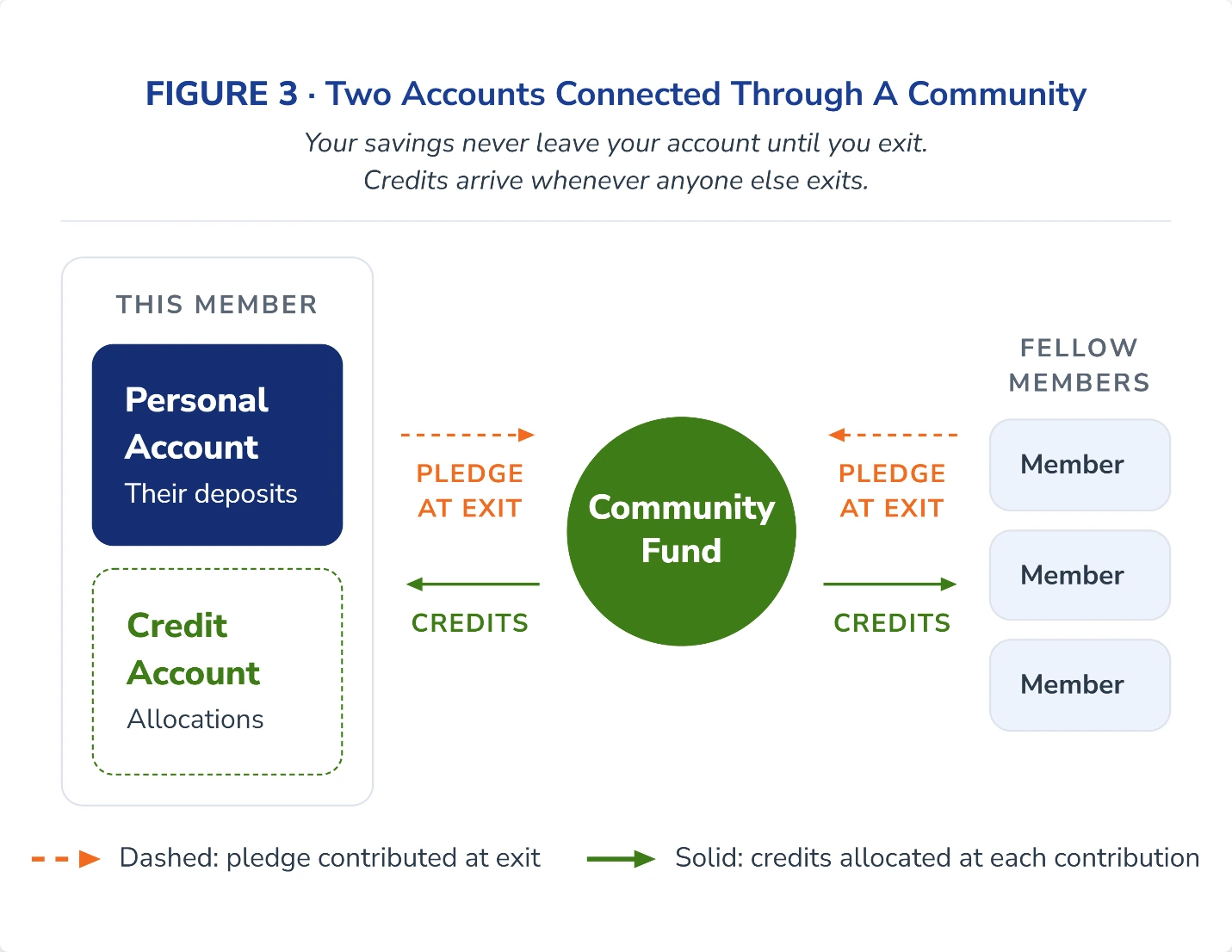
From a member’s perspective, CLIP is easiest to understand as two accounts connected through one Community Fund.
The Personal Account is a member’s own savings, entirely owned by the member, invested and controlled by the member, never used to pay anyone else, providing one source of retirement income.
The Credit Account is an accounting record tracking a member’s share of the Community Fund over time, also never used to pay other members directly. It grows whenever other members exit and make a contribution. It is the second source of retirement income.
The Community Fund works differently from the two accounts above. It isn’t a member’s own account in the way that the Personal Account and the Credit Account are. It is the pooling mechanism that connects each member to everyone else. It receives pledged contributions whenever they become due at a member’s exit, and it generates the credits that are allocated to all the remaining members.
The Pledge
Every deposit a member makes carries a pledge. This is a fraction of that specific deposit that the member commits to contribute to the Community Fund when they eventually leave the pool. The member selects this fraction at the time of deposit and, once it is set, it does not change for that particular deposit. The pledge itself is not a payment made today. Nothing moves out of the member’s Personal Account when the pledge is made. It is simply a commitment about what happens to that portion of the Personal Account at a later date, on exit.
A member can think about the pledge as a dial. A lower pledge leaves more of the Personal Account to the member’s beneficiaries. A higher pledge increases the member’s participation in the pool in exchange for a potentially higher allocation of credits. Neither setting is right or wrong and neither guarantees a particular result. It is a tradeoff that the member chooses for themselves.
The Credits
Credits provide another source of savings available to a member. They are created when another member exits and makes a contribution to the Community Fund. These credits are then allocated to remaining members in their Credit Accounts. Unlike deposits to the Personal Account which typically stop at retirement, credits continue to be allocated for as long as the member remains in the pool, from the day they join to the day they exit. A member can only use credits to generate income during retirement, and they are not otherwise usable. When a member exits, credits are returned to the pool and reallocated to other members.
How Retirement Income Is Paid
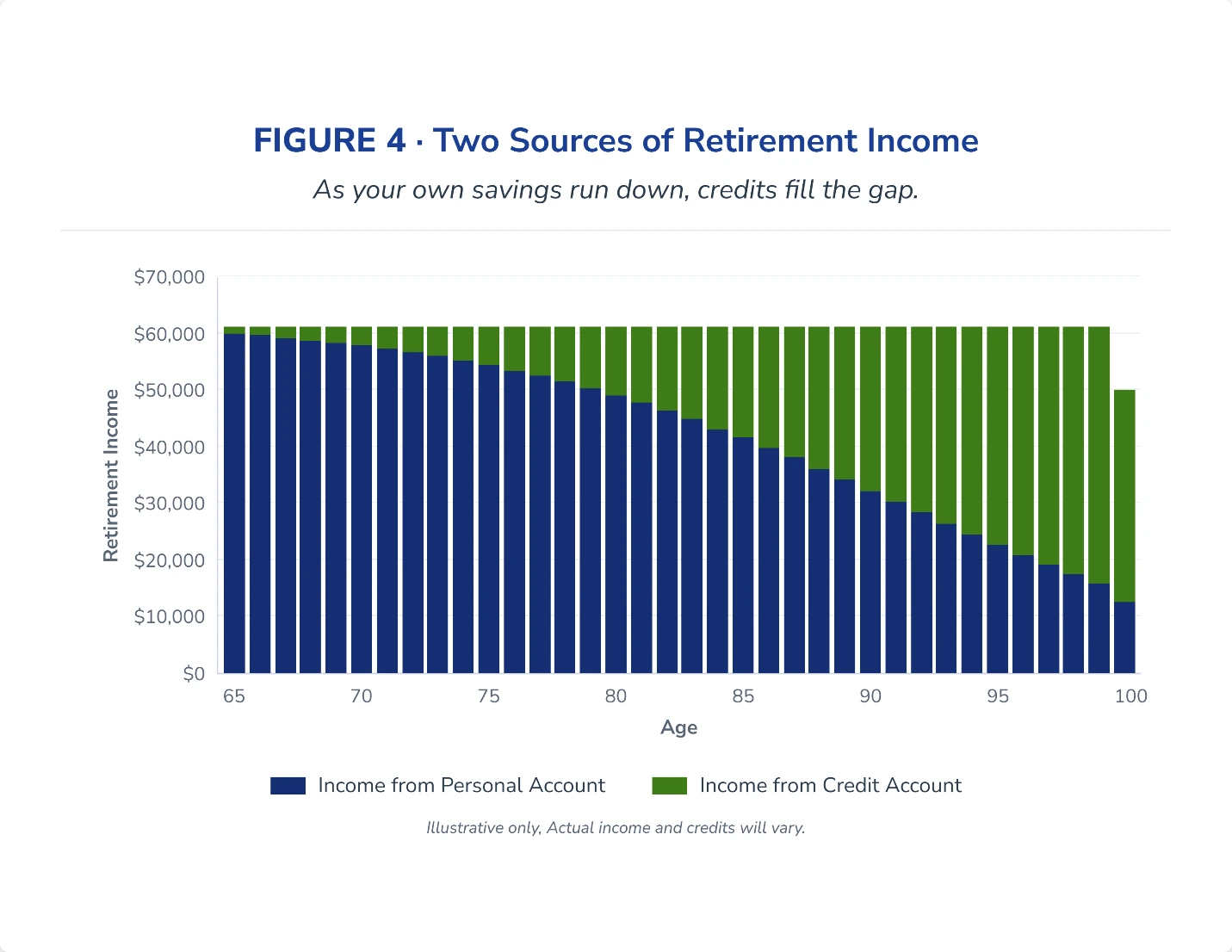
At retirement, a member selects the amount of retirement income that they wish to receive to meet their needs. This income is funded from both the Personal Account and the Credit Account. The member therefore has two sources of retirement income: their own savings and the credits generated through participation in the community.
What Happens at Death or Withdrawal
A member can exit CLIP at any time, either before or after retirement. Death or full withdrawal ends membership. Partial withdrawal continues membership.
Before retirement. The member forfeits some or all the credits in their Credit Account and makes no contribution to the pool from their Personal Account.
After retirement. The pledge applies and a full or partial contribution is made to the Community Fund. Some or all the credits are forfeited.
What CLIP Does
Put these pieces together and the basic idea becomes clear. Members keep control of their own savings while they participate in a pool that can add a second source of retirement income. They choose in advance how much of their remaining savings they are willing to contribute when they exit, allowing them to balance participation in the pool with what they want to preserve for themselves and their beneficiaries.
CLIP is a source of extra retirement income, not an insurance guarantee. CLIP does not guarantee income for life the way that a traditional insured annuity does. CLIP is an alternative pooling mechanism that operates with a different architecture. It does not require an insurance company to stand between members to guarantee income. Credits paid to surviving members are limited to realized contributions from members who have actually left the pool. Nothing more is required from the pooling mechanism.
It’s as simple as that.
Keep a copy
Download the PDF of this paper to read offline or share. The text above is the same paper.